
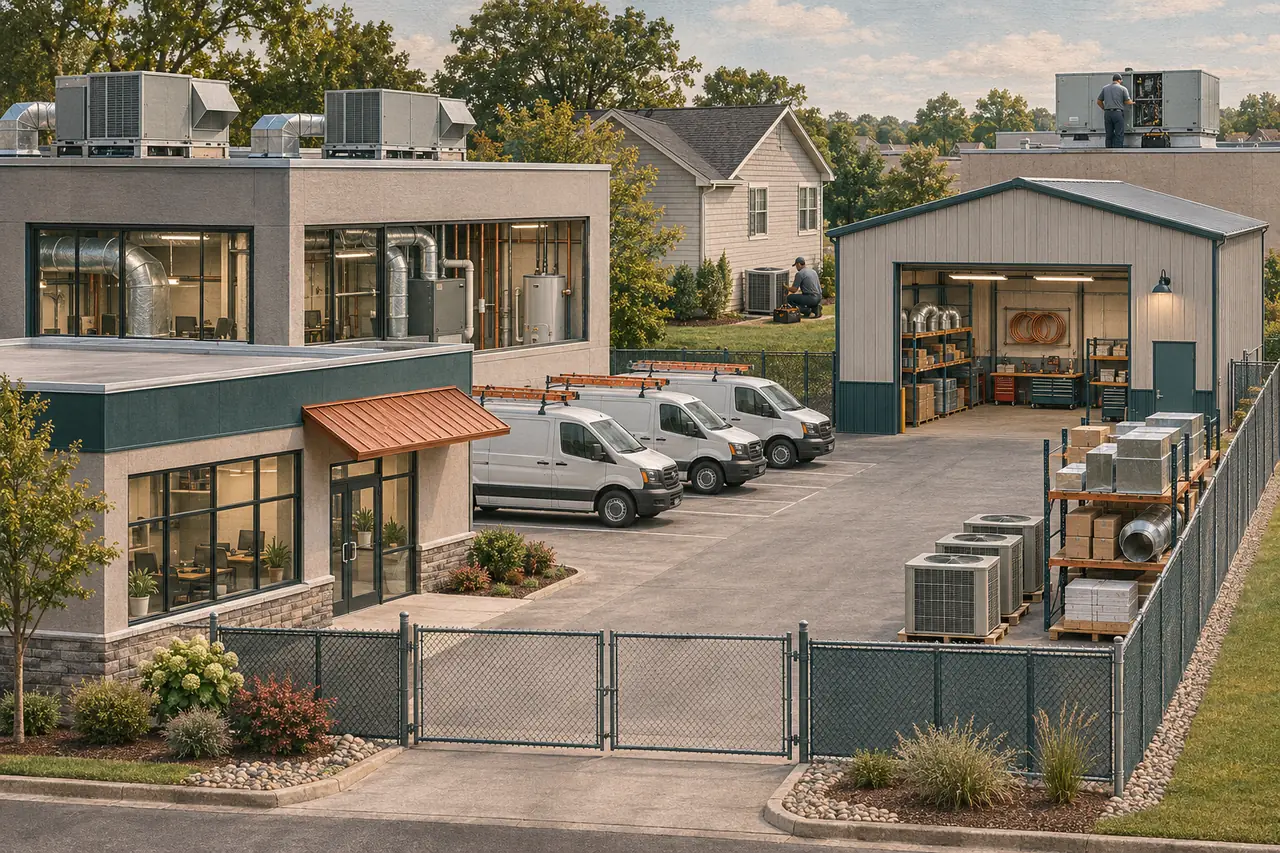
How do you separate the HVAC operation from the property?
Start with two questions. What would the HVAC company earn if it paid a defensible cost to occupy the site? What would a knowledgeable property buyer pay for the land and improvements on their own merits? Keeping these questions separate gives you a business price, a property price and an intelligible combined funding requirement.
A seller might describe a single package containing a service company, warehouse, office, fenced yard and personal tools. The operating entity may own the land directly, lease it from a related LLC or use it without a written lease. Identify the legal owner of each asset and list the agreements connecting the entities. Your purchase contract, valuation work and financing request should refer to the same things.
Ask the owner to walk you through an ordinary dispatch morning. Which doors, parking spaces, racks, loading areas and neighbor access points are essential? Can an equipment truck turn around on the property without crossing another parcel? Where do technicians pick up parts before the office opens? These details do not set market value alone, but they can explain why a seemingly inexpensive alternative building would disrupt field operations.
How do you normalize occupancy without counting it twice?
Rebuild the existing occupancy expense, determine an appropriate market rent on comparable terms and reconcile the difference to operating earnings. Compare like with like. A gross rent that includes certain property expenses is different from a lease where the tenant separately pays taxes, insurance and maintenance.
| Item | Operating-company question | Property or combined question |
|---|---|---|
| Base rent | What would a comparable tenant pay? | What cash actually moves between the proposed entities? |
| Property expenses | Which costs does the assumed tenant retain? | Which costs and reserves does the owner bear? |
| Roof, paving or other capital work | Does the proposed lease assign an obligation? | What inspection and funding plan support ownership? |
| Debt service | How is operating cash measured for the lender? | What payments must the combined transaction support? |
Suppose an illustrative shop shows $500,000 of adjusted operating earnings before occupancy. Comparable evidence supports an annual rent expense of $120,000 under a defined lease structure. If the historic accounts contain none of that rent and no overlapping property expenses, the tenant-level earnings would be $380,000. Now consider a seller who already charged $80,000 for comparable occupancy. In that case the adjustment against reported earnings is the $40,000 difference, subject to expense reconciliation. The same rent assumption can produce very different adjustments depending on the starting point.
Ask a qualified local property professional for comparable uses, size, condition, location and lease structure. A retail storefront can have a very different rent per square foot from a contractor yard with drive-in doors. Retain dates and terms of the evidence. If the business uses only part of the property, measure what it uses and examine whether the rest can be occupied or rented separately under the applicable rules.
What does property diligence need to cover at an HVAC shop?
Inspect the building as a real estate purchase and as an operating site. Review title, survey, zoning or permitted use, insurance, physical condition, access, environmental history and documented improvements with qualified advisers. An attractive purchase price cannot make an unsuitable site support the trucks and materials in your operating plan.
- Confirm the parcels, buildings, easements and fixtures included in the proposed sale.
- Verify the permitted activities for storage, servicing, parking and any planned expansion.
- Inspect the roof, structure, utilities, drainage, paving and loading access with appropriate professionals.
- Review historic property uses and environmental records with a qualified environmental professional and counsel.
- Obtain written estimates and deadlines for material repairs, approvals or further investigation.
Ask about prior tenants and uses as well as current operations. A former use may matter to environmental diligence even if today’s contractor runs a tidy shop. EPA’s All Appropriate Inquiries guidance describes a process relevant to certain protections under federal law. Have the qualified professional and counsel identify the appropriate scope, timing and reliance for your transaction before acquisition. A visual walk-through cannot substitute for a required assessment.
Test the site under ordinary operating conditions. A buyer who visits at noon may see an empty yard while the entire fleet is in the field. Visit when technicians load up and when crews return. Check whether vans block supplier deliveries, whether neighboring land is used informally and whether customers or employees depend on access the seller cannot grant. Identify the cost and operational effect of correcting any material limitation.
Decide which items are fixtures and which are operating assets. Shelving, equipment lifts, generators, security equipment and installed shop systems can appear on both the equipment schedule and the property description. Have the relevant parties agree what transfers, how it will be treated and what stays if the property is leased instead. One signed asset schedule can prevent an expensive closing-day dispute.
What changes if the seller keeps the building?
Build a real lease case, including term, renewals, expense allocation, access, permitted use, assignment and responsibilities for major repairs. Lease economics should reflect the rights the operating buyer actually receives. A lower purchase price for the company can be offset by above-market rent or the risk of losing an essential site.
Suppose your bank expects the business to service acquisition debt for several years, but the proposed lease expires much sooner with no reliable renewal option. The business could face relocation while still servicing the loan. Ask the lender what occupancy evidence it requires and have counsel negotiate appropriate terms in light of the business’s needs. Do not assume a general promise that the seller will take care of you is equivalent to a documented right.
Model a move as a useful comparison even if you hope to stay. Include replacement rent, fit-out, moving equipment, interrupted dispatch, signage, customer communications and additional driving time. A site that is only slightly cheaper may create much higher labor and service costs. Conversely, a buyer with a nearby branch and spare yard capacity may benefit from relocating after an orderly transition. State which version you are underwriting.
If you consider a future purchase option, identify the price mechanism, date, appraisal procedure and responsibilities between closing and exercise. Define what happens if a roof replacement becomes necessary during the lease but before you decide whether to buy. A purchase option can have real value while leaving the tenant responsible for costs that should appear in the operating budget.
How do you compare the combined financing alternatives?
Prepare a sources-and-uses schedule for the business, property, transaction expenses, repairs and working capital. Ask your lender which structures and program requirements apply, including occupancy, eligibility and treatment of related entities. A longer amortization on a building may improve the scheduled payment while requiring more equity or increasing the amount exposed to property risk.
Use the debt-service calculator with the lender’s definitions and actual payment assumptions. A property entity receiving rent from the operating company may use that rent to pay its loan and expenses. In a combined analysis, eliminate internal rent appropriately while retaining actual external property expenses and debt payments. Otherwise the same internal payment can inflate income or depress cash available for debt service.
Use the offer comparison tool to keep cash price, financing and contingent amounts visible for each alternative. Compute an illustrative stress case where the property needs a large repair during a mild service season. Compare the lowest bank balance and ability to meet payroll, supplier bills and debt. A package with a stronger headline return may require a reserve the buyer cannot fund.
Summarize the findings in your buyer diligence workbook. Keep the operating valuation, property appraisal or comparable evidence, inspections and proposed lease or deed separately identified. Record the decision maker and deadline for every unresolved site condition. Your valuation hub can help you keep the earnings adjustments aligned with the transaction you are actually pricing.
Before you release contingencies, return to the first dispatch morning. Can the team enter the building, park the trucks, collect the equipment and legally operate at the site? Can the business fund both its service obligations and the external property payments? Keep those answers in your buying file alongside the two valuations. You are acquiring a field-service operation and making a real estate decision. Each deserves enough evidence to stand on its own.
Also check whether the seller receives rental income from a separate tenant on the same parcel. Inspect the signed lease, payment history, areas used, renewal rights and shared expenses. A buyer should not include that rental income in operating HVAC earnings and again in the property valuation. If the tenant uses the same yard or loading area the service crews need, the lease may reduce operating flexibility even while generating cash. Ask the appraiser and operating manager to review the same floor plan.
At closing, assign responsibility for utility transfers, keys, gate codes, security contacts and deliveries already in transit. A lender can have a complete real estate file while the incoming purchaser still cannot accept an early-morning equipment delivery. Give the dispatch supervisor one reliable property contact and confirm which party responds to an urgent building issue during the transition period.
Where can you go next?
What else should you know?
Can I apply the HVAC company’s earnings multiple to the building?
Estimate business value on earnings after a supportable occupancy expense, then obtain an appropriate property valuation for the real estate. Using the company’s multiple on earnings that omit rent and adding the full building price can overstate combined value. Check how occupancy and property ownership expenses are treated in each calculation.
What if the seller has never charged rent to the HVAC company?
Identify what the operating company paid for taxes, insurance, maintenance and related occupancy costs. Obtain comparable rent for a property with similar use and lease terms, then reconcile the difference. Document which expenses the tenant and landlord would bear so your adjusted earnings do not contain rent and the same property cost twice.
Should I order an environmental review of a contractor’s shop?
Review the property history, proposed financing and transaction with qualified environmental and legal advisers before acquisition. Ask what investigation is appropriate, when it must occur and who may rely on it. The presence of a mechanical shop does not establish contamination. Prior uses, storage and records can change the scope materially.
Is buying the building always better than renting it from the seller?
Compare the actual alternatives. Ownership may secure dispatch and storage capacity while requiring additional equity, maintenance and debt service. A lease may preserve capital while exposing the business to renewal terms and restrictions. Model both with the same operating volume, realistic expenses and a plan for the end of the lease term.
Which sources informed this page?
- Lender and Development Company Loan Programs · U.S. Small Business Administration, November 21, 2026
- All Appropriate Inquiries final rule fact sheet · U.S. Environmental Protection Agency, November 21, 2026
- Business and real estate brokerage · International Business Brokers Association, November 21, 2026